Why Foundation Health Matters in the Ottawa Valley
Your foundation is the most critical structural element of your home. In the Ottawa Valley, our foundations face unique challenges — from the heavy clay soils common around Pembroke and Petawawa to the extreme freeze-thaw cycles that Ontario winters bring. Temperatures can swing from -30°C in January to +30°C in July, and that thermal stress takes a toll on concrete over time.
Catching foundation problems early can save you thousands of dollars in repairs. Here are the five most common warning signs that your concrete foundation needs professional attention.
1. Horizontal or Stair-Step Cracks in Foundation Walls
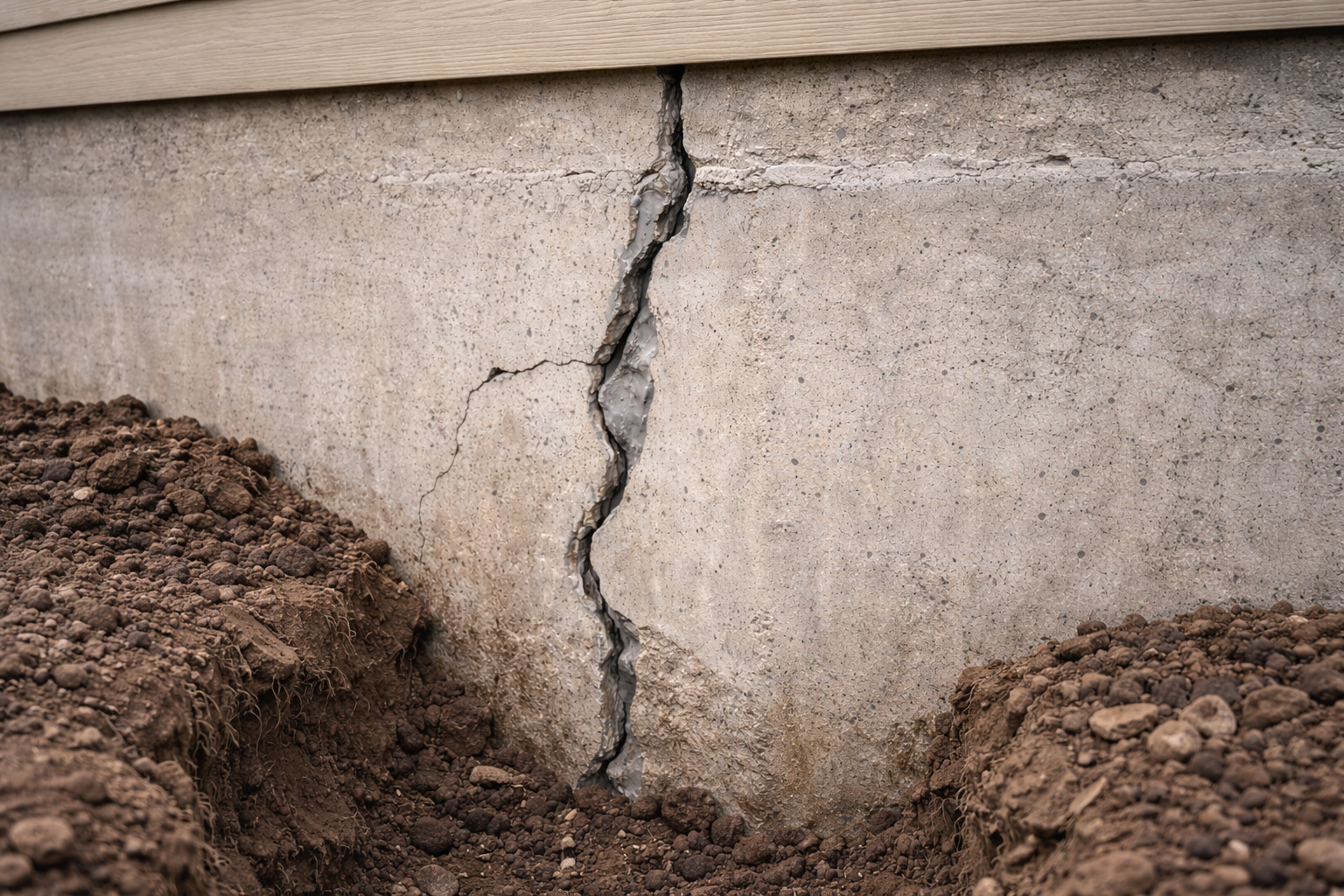
Not all cracks are created equal. Hairline vertical cracks in poured concrete foundations are common and often result from normal curing and minor settling. However, horizontal cracks or stair-step cracks in block foundations are a serious concern.
Horizontal cracks typically indicate lateral pressure from the soil pushing against your foundation walls. In the Ottawa Valley, this is especially common in spring when clay soils absorb snowmelt and expand significantly. If you notice horizontal cracking, particularly if the wall appears to be bowing inward, contact a foundation professional immediately.
- Hairline vertical cracks: Usually cosmetic — monitor but not urgent
- Horizontal cracks: Indicate structural pressure — requires professional assessment
- Stair-step cracks in block walls: Sign of differential settling — needs repair
- Cracks wider than 6mm (1/4 inch): Should be evaluated regardless of direction
2. Water Seepage or Persistent Dampness in Your Basement
If you notice water stains, efflorescence (white mineral deposits), or actual water pooling in your basement, your foundation may have compromised waterproofing or structural cracks that allow moisture penetration.
Ottawa Valley homes are particularly susceptible during the spring thaw. As the deep frost line recedes (which reaches 1.2 to 1.5 metres in our region), melting ice and saturated soil create hydrostatic pressure against foundation walls. Combined with our predominantly clay and silt soils, which drain poorly, this pressure can force water through even small cracks.
Persistent moisture also creates conditions for mould growth, which poses health risks for your family. If your sump pump runs constantly or you smell mustiness in your basement, it is time to investigate.
3. Doors and Windows That Stick or Won't Close Properly
When a foundation shifts or settles unevenly, the entire structure above it moves with it. One of the earliest visible signs is doors and windows that no longer operate smoothly. You might notice:
- Interior doors that drag on the floor or won't latch
- Gaps appearing between door frames and walls
- Windows that are difficult to open or close
- Visible gaps between the wall and ceiling or floor
While a single sticky door might be caused by humidity changes, multiple doors and windows with alignment issues across your home strongly suggest foundation movement. In the Ottawa Valley, differential settling is common where homes are built on mixed soil conditions — part bedrock, part clay — which is frequent in areas like Cobden, Eganville, and along the Ottawa River corridor.
4. Uneven or Sloping Floors
Place a ball on your floor. If it rolls consistently to one side, your foundation may have settled unevenly. While older homes often have minor floor variations, a noticeable slope that has developed or worsened over time indicates active foundation movement.
In our region, this is often caused by soil erosion beneath the footing, frost heave that has permanently displaced part of the foundation, or inadequate compaction during the original construction. Homes built before modern Ontario Building Code requirements for footing depth (which mandate placement below the frost line) are especially vulnerable.
If you measure a slope greater than 25mm (1 inch) over 6 metres, professional evaluation is recommended.
5. Crumbling or Deteriorating Concrete
Concrete that is flaking, spalling, or crumbling — a condition called concrete cancer or spalling — indicates that the material itself is breaking down. In the Ottawa Valley, this is most commonly caused by:
- Freeze-thaw damage: Water enters small pores, freezes, expands, and breaks the concrete apart over repeated cycles
- De-icing salt exposure: Road salt and ice melter tracked near foundations accelerates deterioration
- Poor original mix: Concrete with too high a water-to-cement ratio is more porous and vulnerable
- Age: Foundations from the 1950s-1970s may not have used air-entrained concrete, which is essential for freeze-thaw resistance
If you can chip away pieces of your foundation with a screwdriver, the concrete has lost its structural integrity and likely needs partial or full replacement.
What to Do If You Notice These Signs
If you have identified one or more of these warning signs, the most important step is to get a professional assessment. Foundation problems do not improve on their own — they worsen over time and become more expensive to fix.
At COA Concrete and Construction, we provide honest assessments of foundation conditions for homeowners across Pembroke, Petawawa, Deep River, and the wider Ottawa Valley. We will tell you what needs fixing, what can wait, and what your options are — no pressure and no upselling.
Whether you need crack injection, wall reinforcement, waterproofing, or a full foundation replacement, our team has the equipment and experience to do the job right.
Learn more about our foundation and slab services or explore our concrete repair and restoration work.